In many organizations, safety is not a knowledge issue.
Procedures are in place, risk analyses are accurate, and the prevention advisor knows their job. And yet, it still happens: messages are not followed, measures remain ineffective, and buy-in stays limited.
The problem is rarely what is being said.
It lies in how it is being said.
One message, different realities
Prevention advisors operate daily across different worlds. What a management team sees as risk and liability is often perceived by operators as something that slows down their work. Technical profiles look for logic and detail, while HR tends to focus on well-being and engagement.
Each stakeholder interprets the same message through their own lens.
This makes communication in safety fundamentally more complex than it first appears. It is not just about delivering correct information, but about aligning with how people think, work, and make decisions.
Why “explaining it correctly” is not enough
A lot of safety communication is implicitly based on a rational assumption: if people receive the right information, they will act accordingly.
But behavioral science has shown for years that this is not the case.
Research by Daniel Kahneman highlights that people often make fast, intuitive decisions rather than purely rational ones. Cognitive biases and risk perception also play a major role: some risks are overestimated, others underestimated, depending on context, experience, and emotion.
In other words: information alone rarely changes behavior.
That is why some perfectly well-constructed safety messages still fail to have any real impact.
Communication as a strategic lever
To create impact, communication needs to be approached differently. Not as a transfer of information, but as a lever for behavioral change.
This means that a prevention advisor should not only know what to say, but especially how to say it. The same message requires a different approach depending on the person in front of you.
One simple reality applies: people primarily listen to what feels relevant to them.
When a message aligns with their way of thinking, dialogue becomes possible. When it does not, resistance emerges.
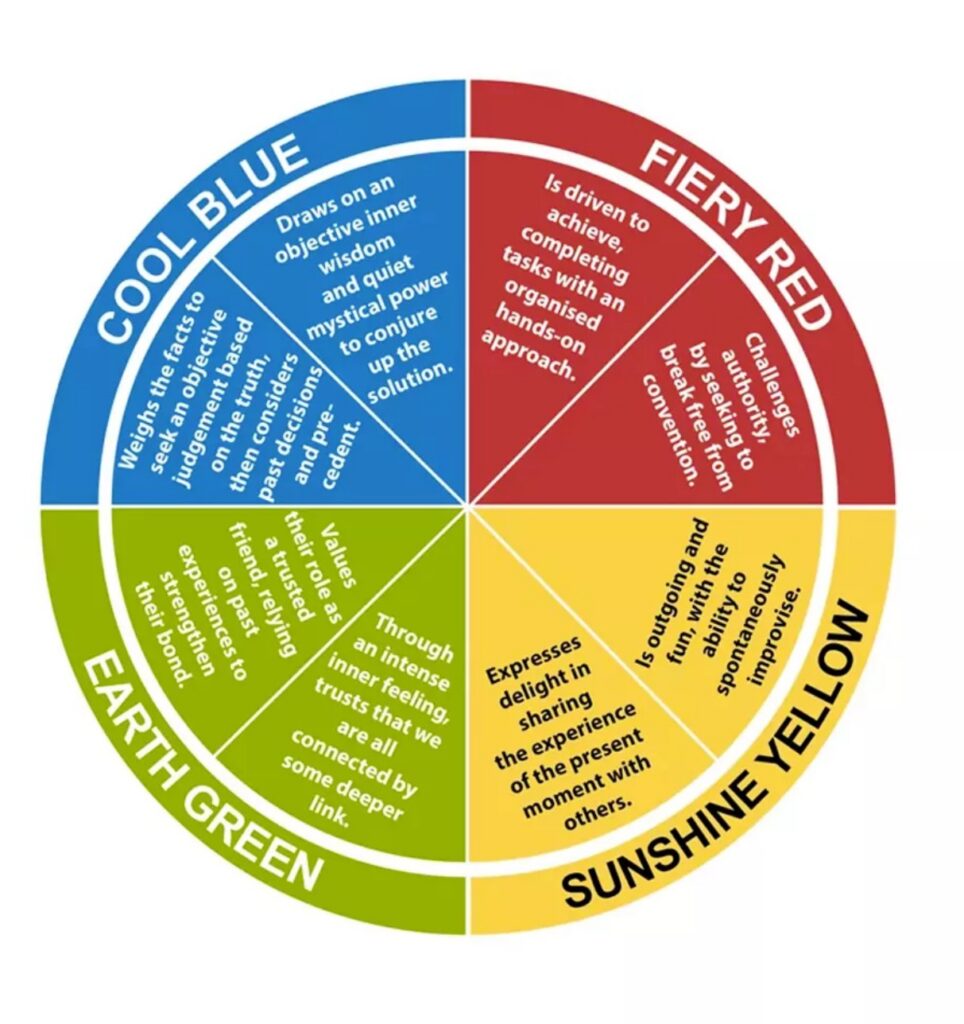

Frameworks such as Insights Discovery and elements of Neuro-Linguistic Programming provide practical tools in this context. They help assess how someone communicates and makes decisions, and how to adapt your own approach accordingly.
This is not about tricks, but about effectiveness. Adjusting your communication simply increases the likelihood that your message will actually land
A concrete difference in approach
Consider a common situation: you need to convince an employer to invest in an additional safety measure.
The content of your message may be perfectly solid.
The numbers are correct, the risk analysis is clear, and your recommendation is relevant.
And yet, the conversation stalls.
Why? Because the way you communicate does not match your counterpart.
An employer with more “red” traits — result-oriented, direct, and decisive — has little patience for five detailed Excel sheets or lengthy technical explanations. They want to know quickly: what is the issue, what is the impact, and what decision needs to be made?
Conversely, an employer with more “blue” traits — analytical, structured, and detail-oriented — will react negatively to a fast,
intuitive pitch without proper justification. In that case, a well-prepared, data-driven, and logically structured explanation is expected.
The content of the message remains the same.
But the form, structure, and pace of communication make all the difference.
And that is the key: it is not what you say that convinces, but how well you align with your audience.
Be careful: no one is just one “color.” Behavior is context-dependent and shifts with situation, pressure, and role — putting people in boxes removes nuance… and reduces impact
And what about the Rose of Leary?
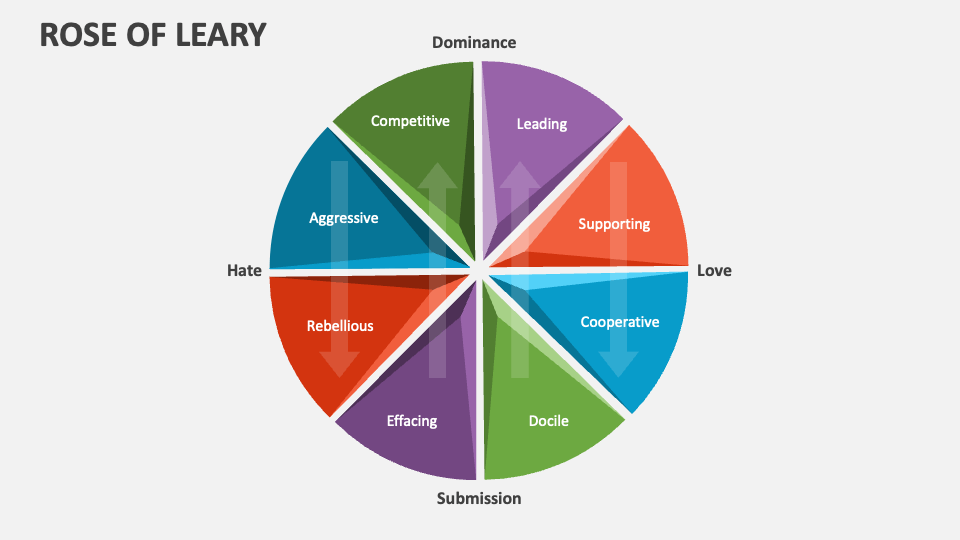
In communication theory, the Rose of Leary is often referenced. This model helps to understand interpersonal interactions and shows how certain behaviors trigger predictable responses.
It is particularly useful for analyzing relational dynamics, especially in situations involving tension or conflict.
However, it remains primarily descriptive. It helps explain what is happening in an interaction, but offers fewer concrete tools for adapting the content and structure of your message to different types of stakeholders.
This is where approaches such as Insights and NLP bring additional value. They focus not only on observable behavior, but also on perception, language, and communication preferences.
Where the Leary Circle helps you read interactions, these approaches help you actively shape and influence them. It helps explain what is happening in an interaction, but offers fewer concrete tools for adapting the content and structure of your message to different types of stakeholders.
This is where approaches such as Insights and NLP bring additional value. They focus not only on observable behavior, but also on perception, language, and communication preferences.
Where the Rose of Leary helps you read interactions, these approaches help you actively shape and influence them.
The evolving role of the prevention advisor
Today’s prevention advisor is more than a technical expert.
They act as a bridge between different interests, a translator of risk into operational reality, and increasingly as an influencer within the organization.
Field experience and training programs clearly show that technical accuracy alone is not enough. Real change only happens when communication is adapted to the audience.
That is where buy-in is created.
That is where safety becomes effective.
In conclusion
Safety is not only about procedures or regulations.
It is about people making decisions, often under pressure, often quickly, and rarely in a purely rational way.
To create impact, you need to go beyond the content.
And that is exactly where communication makes the difference.
Not by saying more.
But by aligning better.

Michaël Marbais
Entrepreneur and Level 1 Prevention advisor.
As managing partner of Kingsm3n, Ken Do It and S.Godart, he helps companies turn safety, security, leadership, and people-centred policies into concrete action – in every routine and every crisis.