The alarm goes off.
Employees leave the building. A few minutes later, everyone is at the assembly point.
Four minutes. A good result.
But does that mean the evacuation drill was successful? Not necessarily.
Evacuation time is a useful indicator, but it only tells part of the story. Perhaps the alarm could not be heard everywhere. Perhaps some employees did not know what was expected of them. Perhaps a supplier was overlooked. Perhaps communication between the evacuation coordinators was chaotic. And perhaps no one at the assembly point could confirm with certainty that the building had actually been completely evacuated.
An evacuation drill is therefore much more than a stopwatch test.
It is an audit of your emergency organization in action.
And such a drill is not optional. Belgian legislation requires employers, among other things, to establish procedures for the evacuation of people and to inform and train employees accordingly. An evacuation drill must be organized at least once a year.
However, once a year is a legal minimum, not a guarantee that your organization actually masters the evacuation process.
A good evacuation drill reveals weaknesses
A drill in which everything goes perfectly may seem like good news. But if not a single weakness is identified, the exercise may not have taught you very much.
That is why we always look beyond evacuation time alone.
How do employees respond to the alarm? Does everyone know their role? Is communication effective? Are visitors and other third parties taken into account? Have all areas been checked, and do we know with certainty that everyone is out of the building?
Discovering a “mistake” during a drill is therefore not a failure.
It is a risk you identify before it becomes a problem during a real emergency.
Evacuation is probably not your core business
And that is an important starting point.
A hotel is expected to welcome guests. A nursing or residential care home looks after its residents. less frequently and is therefore more easily forgotten. A manufacturing company produces. People in an office building focus on their day-to-day work. A logistics company needs to process goods efficiently. And even within a Seveso establishment, where emergency planning is much more developed, responding to an actual emergency is fortunately not a daily activity.
Actually evacuating under emergency conditions? Fortunately, that is something they rarely have to do.
This also means that knowledge of evacuation procedures is used
Procedures that seem perfectly clear on paper may suddenly be far less straightforward under time pressure
In many organizations, staff turnover adds another challenge.
New employees join, experienced employees leave, and responsibilities change. An evacuation organization that was perfectly structured two years ago may today consist of people who are barely aware that they have a role in it.
That is why simply establishing an evacuation procedure once is not enough. It must be tested regularly, adjusted where necessary and repeatedly embedded within the organization.
An evacuation is also a test of leadership
During a real evacuation, there is no ideal meeting-room situation where everyone can calmly consult the procedure.
There is noise. People ask questions. Information is incomplete. Someone has seen something that someone else has not. Decisions have to be made while the situation continues to evolve.
That is when leadership becomes essential.
Who takes the initiative? Who maintains an overview of the situation? Who communicates clearly? Who is prepared to make a decision? And who checks whether instructions are actually being carried out?
Employees with an active role during an evacuation therefore need more than just knowledge of their tasks. They must also be able to direct people under pressure, structure information and communicate efficiently with one another.
That last point in particular is sometimes underestimated.
When different evacuation coordinators, receptionists, team leaders or other key people each hold part of the information, that information needs to reach the right person quickly.
More communication does not necessarily mean better communication.
The real question is: who communicates what, to whom, through which means, and at what moment?
There are practical solutions and clear communication structures for this.
And what about visitors and people with reduced mobility?
Evacuation procedures are often developed primarily from the perspective of an organization’s own employees.
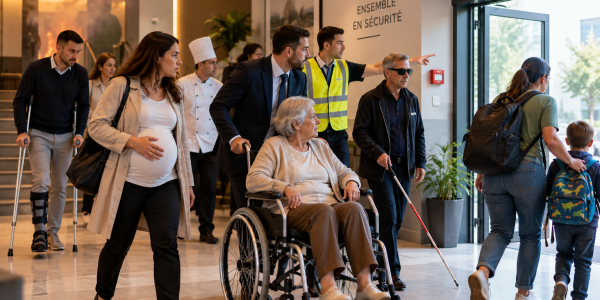
But when the alarm goes off, customers, visitors, suppliers, contractors, temporary workers, trainees, people with reduced mobility or other third parties may also be present.
They may not know the building. They may not know where the emergency exits are, nor be familiar with your assembly point or procedures.
An organization therefore needs to know not only how to evacuate its employees, but also how to maintain an overview of the third parties present at any given time and who is responsible for them during an evacuation.
This becomes even more important in buildings where people are constantly entering and leaving.

But what happens at 2 a.m.? Tested at 2 p.m.
An evacuation organization that works during the day will not automatically work at night.
Fewer employees are present. Some key people are absent. Reception or on-duty staff suddenly have much greater responsibility. And depending on the activity, a considerable number of third parties may still be present at the same time.
Think, for example, of hotels, residential facilities, logistics operations or companies with night shifts.
The ratio may even be completely reversed: many people who do not know the building well, with only a few employees available to organize the evacuation.
A mature evacuation procedure therefore takes different occupancy scenarios into account instead of focusing exclusively on the most comfortable daytime situation.
Recognizable evacuation challenges? Fortunately, there are solutions
High staff turnover, third parties in the building, unclear responsibilities, poor communication, night-time occupancy, limited experience, insufficient leadership or the tension between safety and security are not exceptional problems.
They are common challenges that virtually every organization faces to a greater or lesser extent.
And there are solutions.
And there are solutions.
Kingsm3n can support organizations in developing, analyzing and optimizing emergency and evacuation procedures, defining roles and responsibilities, establishing practical communication structures, and preparing and supervising evacuation drills.
During a drill, we therefore look not only at how quickly everyone gets out of the building, but above all at why the system works — and where it could fail when it really matters.
First know it. Then repeat it. Then test it..
From announced drills to realistic scenarios
Not every evacuation drill needs to be equally complex. On the contrary: an organization that has not yet mastered its basic procedure will gain little from a complicated scenario involving smoke, casualties and blocked evacuation routes.
That is why we prefer to build up evacuation drills step by step.
Level 1 – The announced evacuation drill
In the first phase, the drill is announced in advance. The objective is not to surprise employees, but to ensure that everyone learns how to perform their role correctly.
Who takes the lead? Who checks which area? Who assists visitors or other third parties? Who communicates with whom? Who collects the information at the assembly point?
At this stage, the focus is on knowing, performing and practising the procedure.
Level 2 – The unannounced evacuation drill
Once the basics have been sufficiently mastered, the next drill can take place without prior announcement.
No additional difficulties are deliberately introduced at this stage. The challenge is to determine whether the organization spontaneously and correctly applies the procedure it has learned when the alarm sounds unexpectedly.
This is where the difference becomes apparent between knowing what the procedure says and actually mastering it.
Level 3 – A realistic scenario with unexpected challenges
In the next phase, the level of difficulty can be increased. The evacuation drill itself may be announced or unannounced, but realistic elements that participants are not aware of beforehand are introduced during the exercise.
Examples include a simulated casualty, a person with reduced mobility, simulated smoke, an unavailable evacuation route, an absent key person or another situation that could arise during a real emergency.
The objective is not to “catch employees out”. The objective is to observe how the emergency organization responds when reality deviates from the ideal scenario.
Because that is precisely when communication, decision-making, leadership and the robustness of the procedure are truly tested. he objective is to observe how the emergency organization responds when reality deviates from the ideal scenario.
Because that is precisely when communication, decision-making, leadership and the robustness of the procedure are truly tested.
How Kingsm3n tests your evacuation organization in practice
For us, a good evacuation drill does not begin when the alarm goes off, nor does it end when everyone reaches the assembly point.
We work in three phases.
- Preparation and selection of the scenario
Beforehand, we review the existing evacuation and emergency procedures together with the contact person. We assess whether they still correspond to the actual situation within the organization and adjust them where necessary.
We then determine what we want to test during the drill and select the appropriate scenario and level of difficulty. After all, a good exercise starts with clear objectives, not with the ambition to include as many surprises as possible in a single scenario.
- The day of the drill: briefing, observing and debriefing
On the day itself, depending on the selected scenario, we provide a briefing for the parties involved. Where useful, we briefly review the main roles and expectations.
Before starting, we also take the necessary precautions to prevent the exercise from being mistaken for a real emergency. Where relevant to the alarm or emergency notification procedure in use, the relevant monitoring center, alarm receiving center and/or emergency services are informed in accordance with the agreed procedure that an exercise will take place.
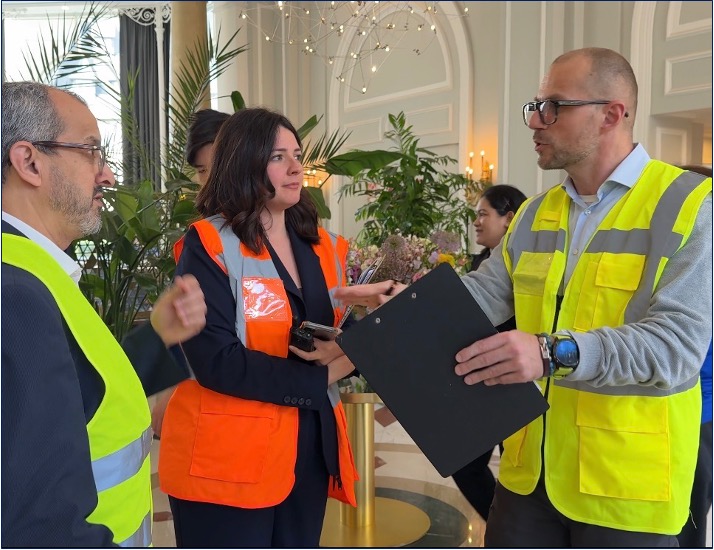
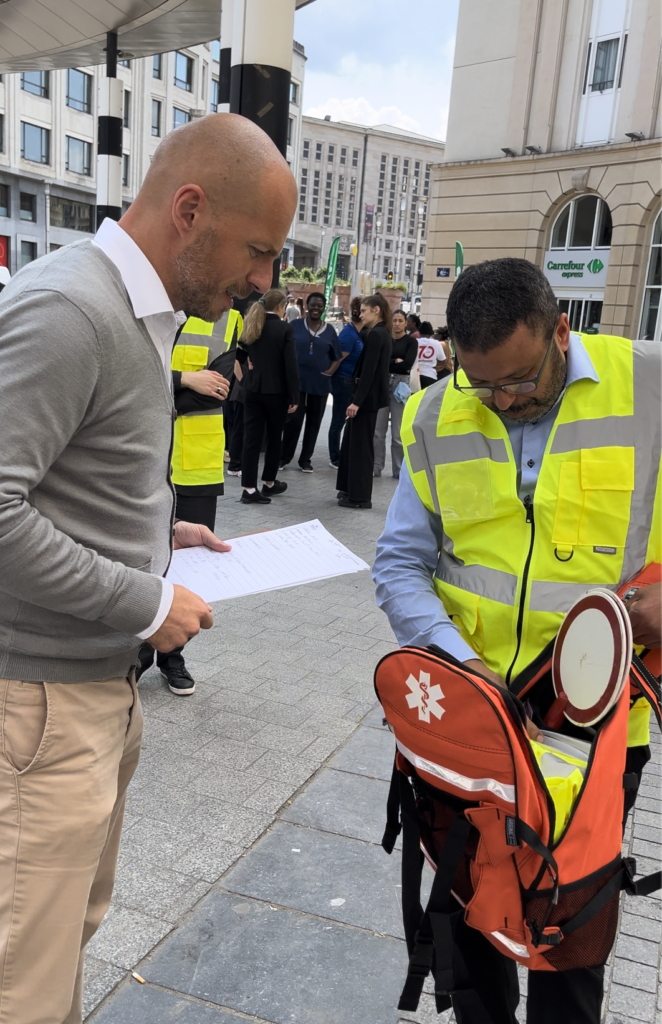
The evacuation drill then begins. Kingsm3n provides at least one observer. For larger buildings, multiple floors, complex sites or more extensive scenarios, several observers may be deployed.
We look far beyond evacuation time alone: the response to the alarm, compliance with the procedure, communication, leadership, checking of areas, assistance to third parties, behavior at the assembly point and the way unexpected situations are handled.
Immediately afterwards, a debriefing with the employees involved takes place. What went well? Where did uncertainty arise? What worked differently than expected? What information was missing?
This immediate feedback is particularly valuable: the exercise is still fresh in everyone’s mind, and participants can explain why they made certain decisions.
- From observation to concrete improvement measures
An evacuation drill without follow-up has only limited value.
That is why we document the exercise in a comprehensive report, including our observations, strengths, identified weaknesses and concrete proposals for improvement measures.
Where relevant, we link our findings and recommendations to the applicable Belgian legislation and regulations, including the Code on Well-being at Work and the applicable fire prevention and evacuation requirements.
This way, an evacuation drill does not end with the conclusion “everyone was outside within four minutes”, but with clear answers to three far more important questions:
What worked? What did not work? And what are we going to improve before the next drill?

Michaël Marbais
Entrepreneur and Level 1 Prevention advisor.
As managing partner of Kingsm3n, Ken Do It and S.Godart, he helps companies turn safety, security, leadership, and people-centred policies into concrete action – in every routine and every crisis.